Daily Real Estate Blog

We hope you enjoy keeping up on the latest happenings in Snohomish and King County Real Estate market, trends, and real estate tips for buyers and sellers. 

Feb. 22, 2017

Are You 1 of the 59 Million Planning to Buy This Year?

Are You 1 of the 59 Million Planning to Buy This Year? | MyKCM

According to a survey conducted by Bankrate.com, one in four Americans are considering buying a home this year. If this statistic proves to be true, that means that 59 million people will be looking to enter the housing market in 2017.

The survey also revealed 3 key takeaways:

  1. Those most likely to buy are ‘Older Millennials’ (ages 27-36) or ‘Generation X’ (ages 37-52)
  2. Minorities, particularly African-Americans, were twice as likely to respond that they were considering purchasing a home this year than white respondents.
  3. Many potential buyers believe they need to put 20% down and need to have perfect credit to own and are unaware of programs that would allow them to buy now.

Holden Lewis, a mortgage analyst for Bankrate.com, pointed to one big reason why many Americans are starting to consider homeownership:

“Having kids and raising a family is a primary reason why Americans take the leap into homeownership—many consider it a key component of the American dream.”

Bottom Line

If buying a home is a part of your dream for 2017, let’s get together to determine if you are able to.

Posted in Home Buyers
Feb. 17, 2017

Do You Know the Real Cost of Renting vs. Buying?

Do You Know the Real Cost of Renting vs. Buying? [INFOGRAPHIC] | MyKCM

Some Highlights:

  • Historically, the choice between renting or buying a home has been a close decision.
  • Looking at the percentage of income needed to rent a median-priced home today (30%), vs. the percentage needed to buy a median-priced home (15%), the choice becomes obvious.
  • Every market is different. Before you renew your lease again, find out if you could use your housing costs to own a home of your own!
Posted in Home Buyers
Feb. 16, 2017

The Impact of Homeownership on Civic Involvement


The Impact of Homeownership on Civic Involvement | MyKCM

The National Association of Realtors recently released a study titled 'Social Benefits of Homeownership and Stable Housing.’ The study confirmed a long-standing belief of most Americans:

“Owning a home embodies the promise of individual autonomy and is the aspiration of most American households. Homeownership allows households to accumulate wealth and social status, and is the basis for a number of positive social, economic, family and civic outcomes.”

Today, we want to cover the section of the report that quoted several studies concentrating on the impact homeownership has on the civic participation of family members. Here are some of the major findings on this issue revealed in the report:

  • Homeowners have a much greater financial stake in their neighborhoods than renters. With the median national home price in 2015 at $223,900, even a 5% decline in home values will translate into a loss of more than $11,195 for a typical homeowner.
  • Because owners tend to remain in their homes longer, they add a degree of stability to their neighborhood.
  • Homeowners also reap the financial gains of any appreciation in the value of their home, so they also tend to spend more time and money maintaining their residence, which also contributes to the overall quality of the surrounding community.
  • Homeowners were found to be more politically active than renters with 77% of homeowners saying they had at some point voted in local elections compared with 52% of renters.
  • There seems to be a greater awareness of the political process among homeowners. About 38% of homeowners knew the name of their local school board representative, compared with only 20% of renters.
  • There is a higher incidence of membership in voluntary organizations and church attendance among homeowners.
  • Homeownership does create social capital and provide residents with a platform from which to connect and interact with neighbors.
  • Owning a home means owning part of a neighborhood, and a homeowner’s feelings of commitment to the home can arouse feelings of commitment to the neighborhood, which, in turn, can produce interactions with neighbors.

Bottom Line

People often talk about the financial benefits of homeownership. As we can see, there are also social benefits of owning your own home.

*Next Thursday, we will report the study’s findings on the impact homeownership has on a family’s health.

Posted in Home Buyers
Feb. 15, 2017

The Great News About Rising Prices for Homeowners

The Great News About Rising Prices for Homeowners | MyKCM

Recently there has been a lot of talk about home prices and if they are accelerating too quickly. As we mentioned before, in some areas of the country, seller supply (homes for sale) cannot keep up with the number of buyers out looking for a home, which has caused prices to rise.

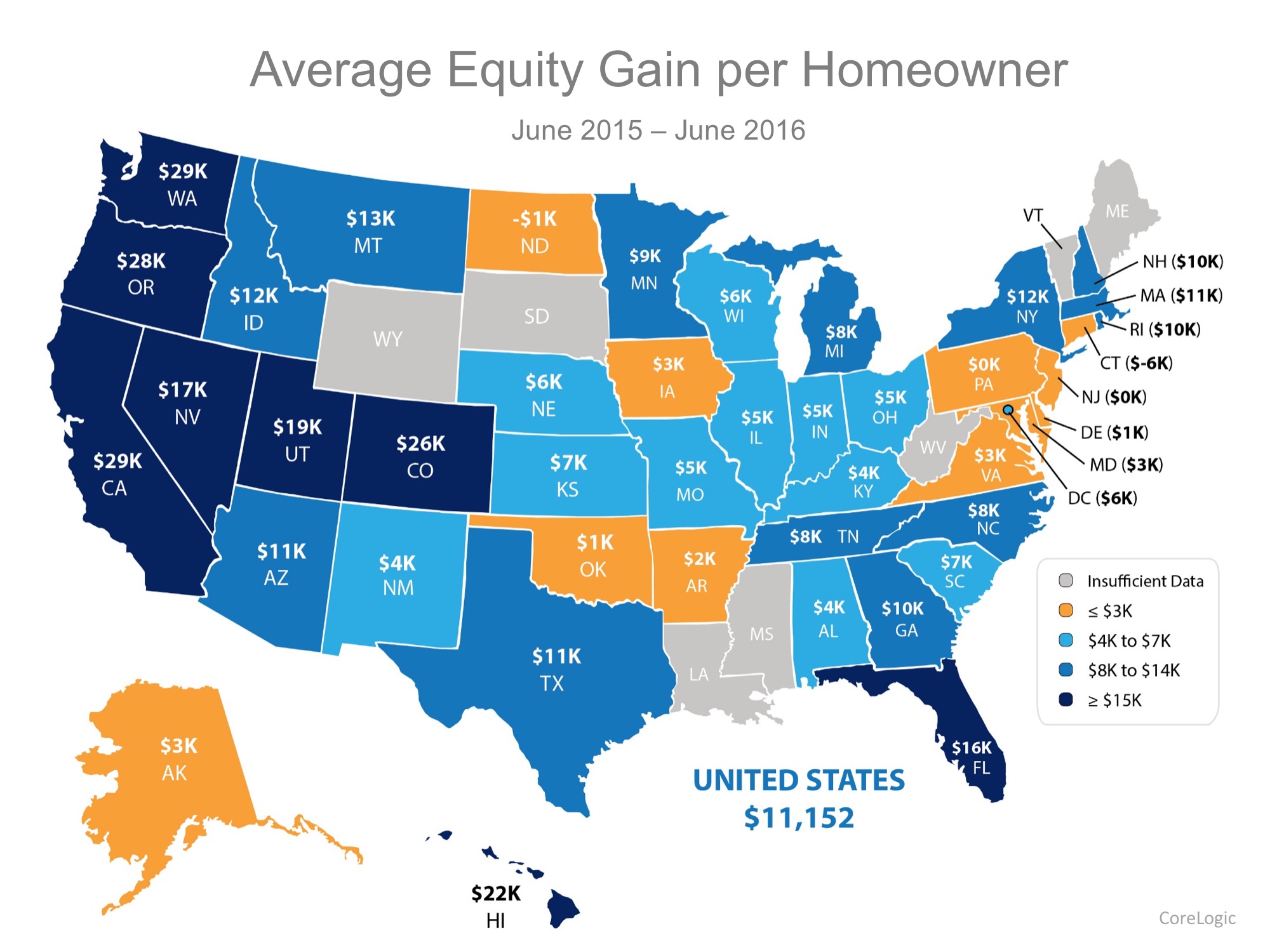
The great news about rising prices, however, is that according to CoreLogic’s US Economic Outlook, the average American household gained over $11,000 in equity over the course of the last year, largely due to home value increases.

The map below was created using the same report from CoreLogic and shows the average equity gain per mortgaged home from June 2015 to June 2016 (the latest data available).

The Great News About Rising Prices for Homeowners | MyKCM

For those who are worried that we are doomed to repeat 2006 all over again, it is important to note that homeowners are investing their new-found equity in their homes and themselves, not in depreciating assets.

The added equity is helping families put their children through college, invest in starting small businesses, allowing them to pay off their mortgage sooner or move up to the home that will better suit their needs now.

Bottom Line

CoreLogic predicts that home prices will appreciate by another 5% by this time next year. If you are a homeowner looking to take advantage of your home equity by moving up to your dream home, let's get together to discuss your options!

Posted in Home Buyers, Sellers
Feb. 14, 2017

First Comes Love… Then Comes Mortgage?


First Comes Love… Then Comes Mortgage? | MyKCM

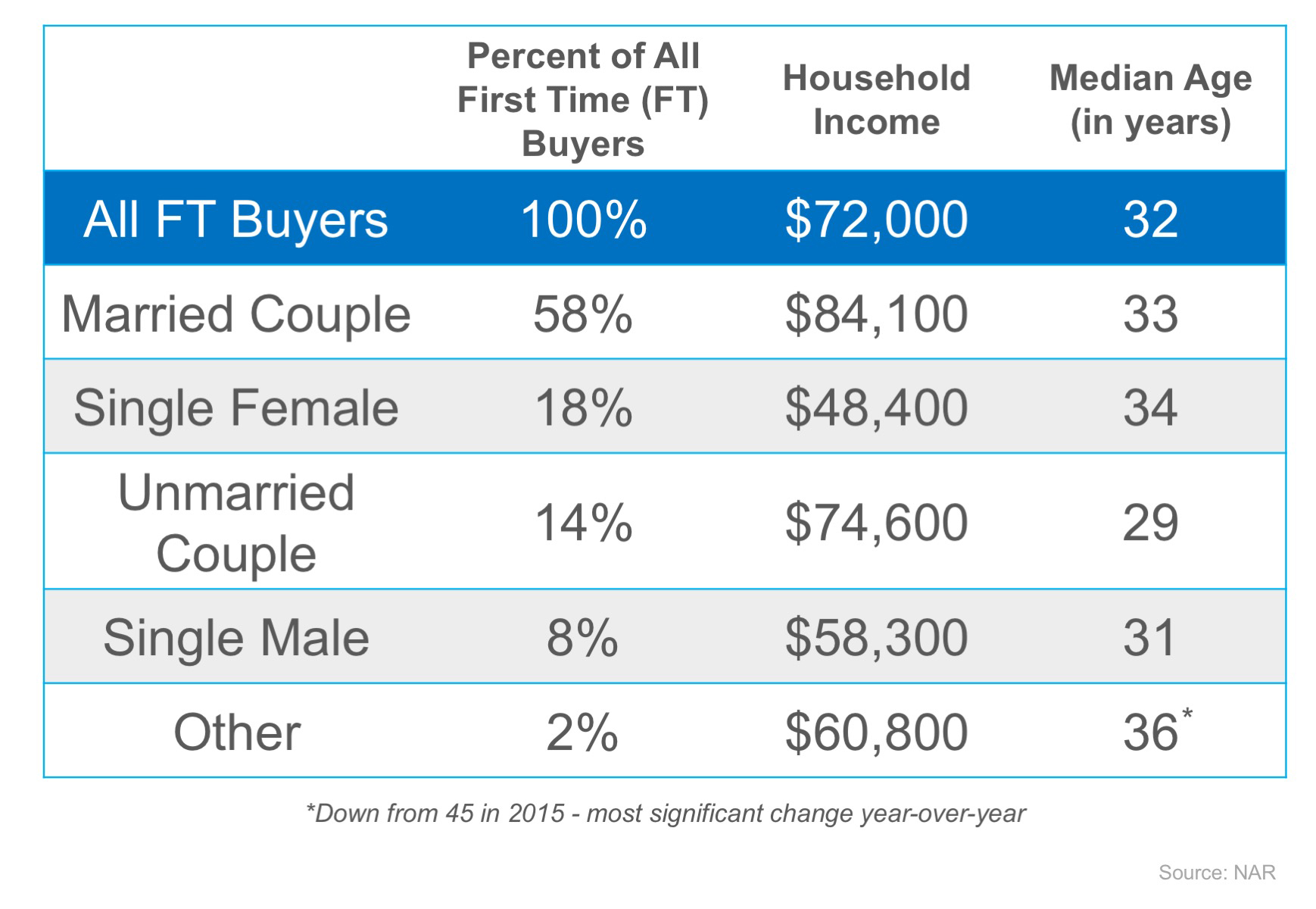
According to the National Association of REALTORS most recent Profile of Home Buyers & Sellers, married couples once again dominated the first-time homebuyer statistics in 2016 at 58% of all buyers. It is no surprise that having two incomes to save for down payments and contribute to monthly housing costs makes buying a home more attainable.

But, many couples are also deciding to buy a home before spending what would be a down payment on a wedding, as unmarried couples made up 14% of all first-time buyers last year.

If you’re single, don’t fret! Single women made up 18% of first-time buyers in 2016, while single men accounted for 8% of buyers. One recent article pointed to a sense of responsibility and commitment that drives many single women to want to own their home, rather than rent.

Here is the breakdown of all first-time homebuyers in 2016 by percentage of all buyers, income, and age:

First Comes Love… Then Comes Mortgage? | MyKCM

Bottom Line

You may not be that much different than those who have already purchased their first homes. Let’s get together to determine if your dream home is already within your grasp!

Posted in Home Buyers
Feb. 13, 2017

3 Questions to Ask If You Want to Buy Your Dream Home


3 Questions to Ask If You Want to Buy Your Dream Home | MyKCM

If you are debating purchasing a home right now, you are probably getting a lot of advice. Though your friends and family will have your best interest at heart, they may not be fully aware of your needs and what is currently happening in the real estate market.

Ask yourself the following 3 questions to help determine if now is a good time for you to buy in today’s market.

1. Why am I buying a home in the first place?

This is truly the most important question to answer. Forget the finances for a minute. Why did you even begin to consider purchasing a home? For most, the reason has nothing to do with money.

For example, a survey by Braun showed that over 75% of parents say “their child’s education is an important part of the search for a new home.”

This survey supports a study by the Joint Center for Housing Studies at Harvard University which revealed that the top four reasons Americans buy a home have nothing to do with money. They are:

  • A good place to raise children and for them to get a good education
  • A place where you and your family feel safe
  • More space for you and your family
  • Control of that space

What does owning a home mean to you? What non-financial benefits will you and your family gain from owning a home? The answer to that question should be the biggest reason you decide to purchase or not.

2. Where are home values headed?

According to the latest Existing Home Sales Report from the National Association of Realtors (NAR), the median price of homes sold in December (the latest data available) was $232,200, up 4.0% from last year. This increase also marks the 58th consecutive month with year-over-year gains.

If we look at the numbers year over year, CoreLogic forecasted a rise by 4.7% from December 2016 to December 2017. On a home that costs $250,000 today, that same home will cost you an additional $11,750 if you wait until next year.

What does that mean to you?

Simply put, with prices increasing each month, it might cost you more if you wait until next year to buy. Your down payment will also need to be higher in order to account for the higher price of the home you wish to buy.

3. Where are mortgage interest rates headed?

A buyer must be concerned about more than just prices. The ‘long-term cost’ of a home can be dramatically impacted by even a small increase in mortgage rates.

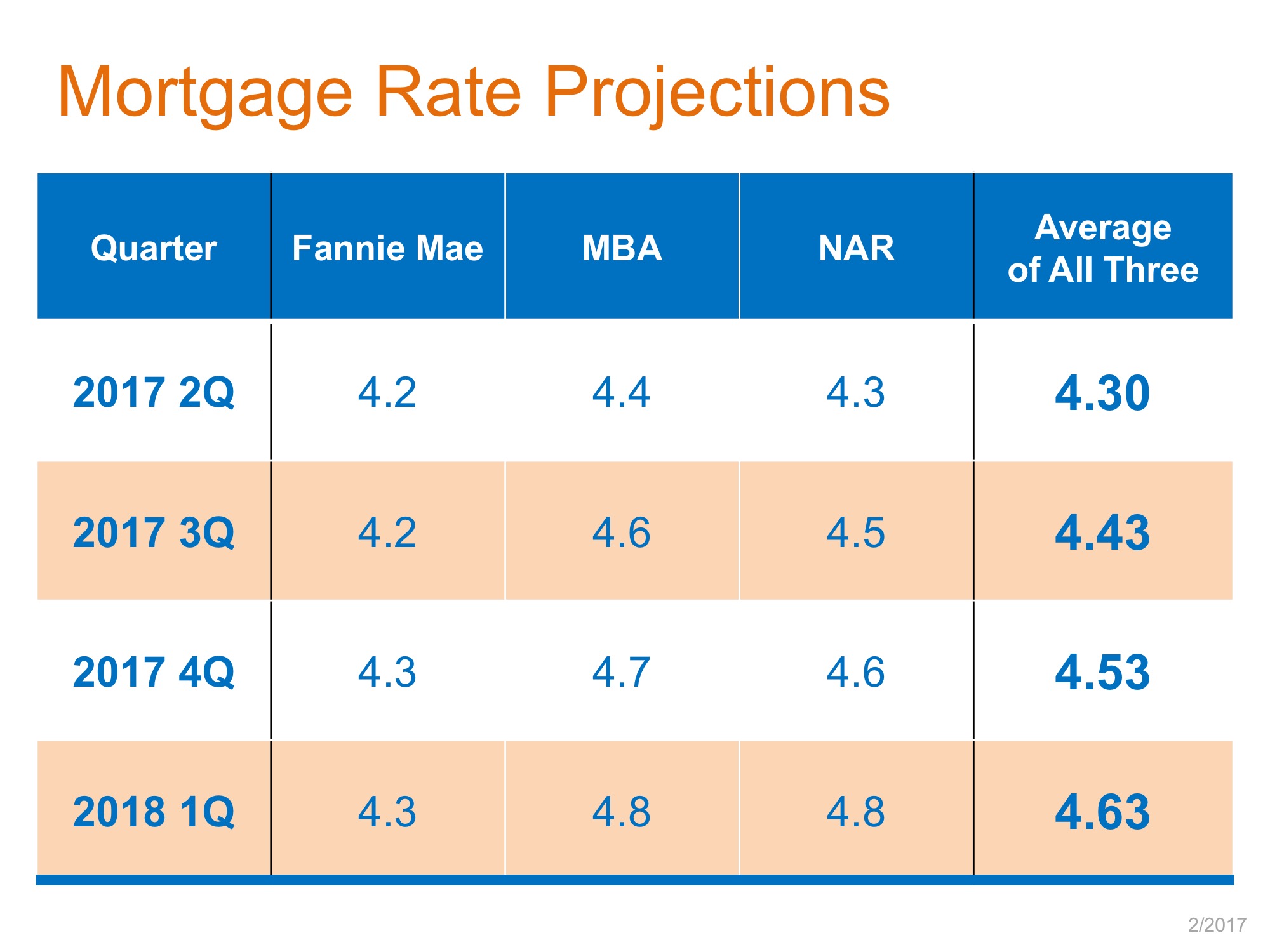
The Mortgage Bankers Association (MBA), the National Association of Realtors, and Fannie Mae have all projected that mortgage interest rates will increase over the next twelve months, as you can see in the chart below:
3 Questions to Ask If You Want to Buy Your Dream Home | MyKCM

Bottom Line

Only you and your family will know for certain if now is the right time to purchase a home. Answering these questions will help you make that decision.

Posted in Home Buyers
Feb. 10, 2017

Mortgage Rates by Decade Compared to Today

Some Highlights:

  • The interest rate you secure for your mortgage greatly influences your monthly housing costs.
  • In the 1980s, 30-year fixed mortgage rates averaged in the high 12s making the monthly principal and interest payment over $2,000.
  • Interest rates are still at historic lows; this is a great time lock in your housing cost and protect yourself from increasing rents, or refinance your current mortgage.
Posted in Home Buyers
Feb. 10, 2017

5 Reasons to Love Using A RE Pro


5 Reasons to Love Using A RE Pro [INFOGRAPHIC] | MyKCM

Highlights:

  • Hiring a real estate professional to guide you through the process of buying a home or selling your house can be one of the best decisions you make!
  • They are there for you to help with paperwork, explaining the process, negotiations, and helping you with pricing (both when making an offer or setting the right price for your home).
  • One of the top reasons to hire a real estate professional is their understanding of your local market and how the conditions in your neighborhood will impact your experience.
Posted in Home Buyers, Sellers
Feb. 9, 2017

Do Homeowners Realize Their Equity Position Has Changed?


Do Homeowners Realize Their Equity Position Has Changed?

Yesterday, we reported that according to CoreLogic’s latest Equity Report, nearly 268,000 homeowners regained equity and are no longer underwater on their mortgage in the first quarter. Homes with negative equity have decreased by 21.5% year-over-year.

A study by Fannie Mae suggests that many homeowners are not aware of how their equity position has changed as their home has increased in value.

For example, their study showed that 23% of Americans still believe their home is in a negative equity position when, in actuality, CoreLogic’s report shows that only 8% of homes are in that position.

The study also revealed that only 37% of Americans believe that they have “significant equity” (greater than 20%), when in actuality, 74% do!

Do Homeowners Realize Their Equity Position Has Changed? | MyKCM
This means that 37% of Americans with a mortgage fail to realize the opportune situation they are in. With a sizable equity position, many homeowners could easily move into a housing situation that better meets their current needs (moving to a larger home or downsizing).

Fannie Mae spoke out on this issue in their report:

“Homeowners who underestimate their homes’ values not only underestimate their home equity, they also likely underestimate: 1) how large a down payment they could make with their home equity, 2) their chances of qualifying for mortgages, and, therefore, 3) their opportunities for selling their current homes and for buying different homes.”

CoreLogic’s report also revealed that if homes were to appreciate by an additional 5%, over 800,000 US households would regain positive equity.

Bottom Line

If you are one of the many homeowners who is unsure of your current equity situation, let's meet up to discuss your options.

Posted in Home Buyers, Sellers
Feb. 9, 2017

The Impact of Homeownership on Educational Achievement


The Impact of Homeownership on Educational Achievement | MyKCM

The National Association of Realtors recently released a study titled 'Social Benefits of Homeownership and Stable Housing.’ The study confirmed a long-standing belief of most Americans:

“Owning a home embodies the promise of individual autonomy and is the aspiration of most American households. Homeownership allows households to accumulate wealth and social status, and is the basis for a number of positive social, economic, family and civic outcomes.”

Today, we want to cover the section of the report that quoted several studies concentrating on the impact homeownership has on educational achievement. Here are some of the major findings on this issue revealed in the report:

  • The decision to stay in school by teenage students is higher for those raised by home-owning parents compared to those in renter households.
  • Parental homeownership in low-income neighborhoods has a positive impact on high school graduation.
  • Though homeownership raises educational outcomes for children, neighborhood stability may have further enhanced the positive outcome.
  • Children of homeowners tend to have higher levels of achievement in math and reading and fewer behavioral problems.
  • Educational opportunities are more prevalent in neighborhoods with high rates of homeownership and community involvement.
  • The average child of homeowners is significantly more likely to achieve a higher level of education and, thereby, a higher level of earnings.

Bottom Line

People often talk about the financial benefits of homeownership. As we can see, there are also social benefits of owning your own home.

*The next two Thursdays, we will report the study’s findings on the impact homeownership has on civic participation and a family’s health.

Posted in Home Buyers