Daily Real Estate Blog

We hope you enjoy keeping up on the latest happenings in Snohomish and King County Real Estate market, trends, and real estate tips for buyers and sellers. 

Jan. 24, 2017

How Low Interest Rates Affect Your Buying Power

How Low Interest Rates Increase Your Purchasing Power

How Low Interest Rates Increase Your Purchasing Power | MyKCM

According to Freddie Mac’s latest Primary Mortgage Market Survey, interest rates for a 30-year fixed rate mortgage are currently at 4.09%, which is still very low in comparison to recent history!

The interest rate you secure when buying a home not only greatly impacts your monthly housing costs, but also impacts your purchasing power.

Purchasing power, simply put, is the amount of home you can afford to buy for the budget you have available to spend. As rates increase, the price of the house you can afford will decrease if you plan to stay within a certain monthly housing budget.

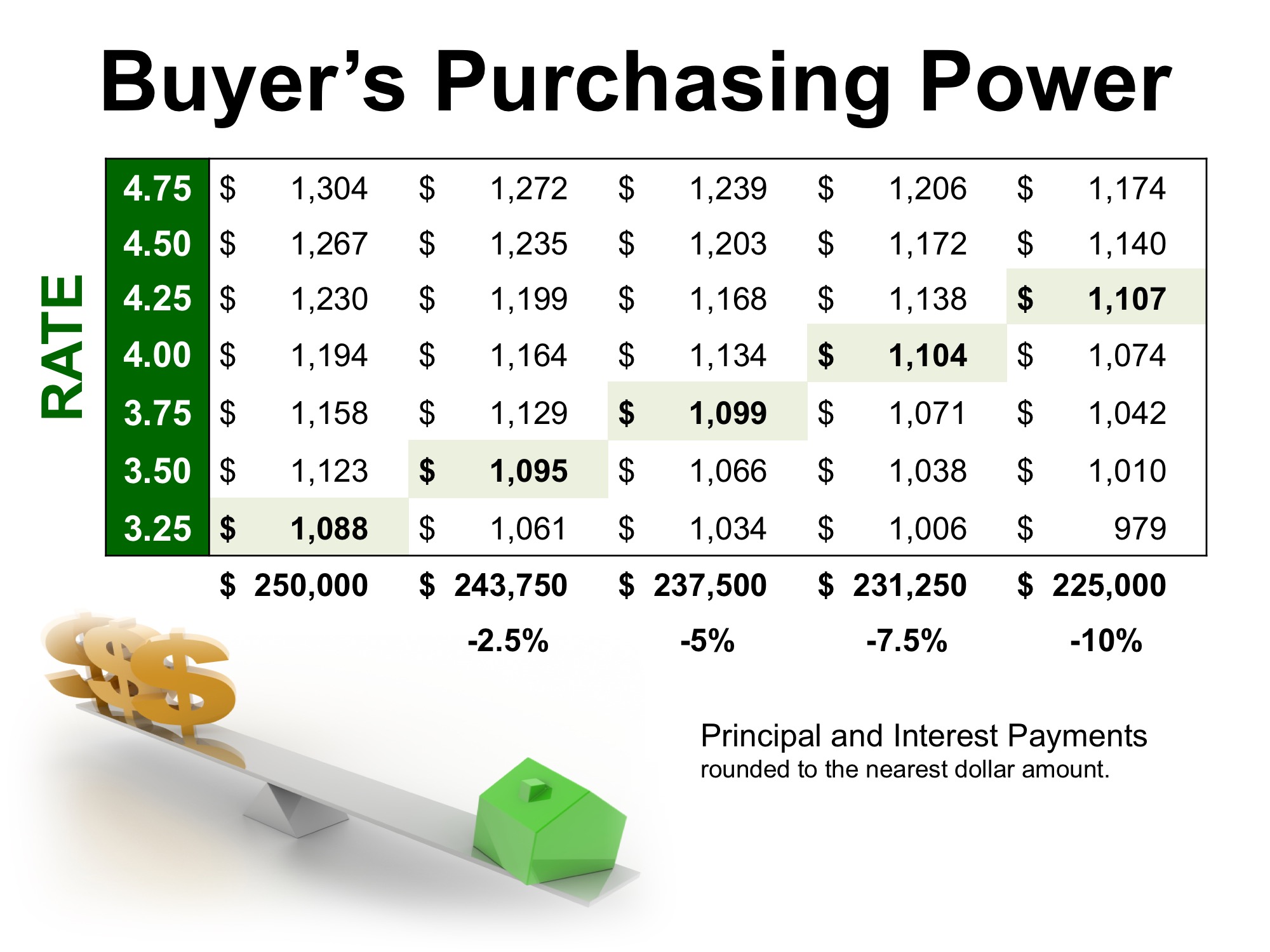
The chart below shows what impact rising interest rates would have if you planned to purchase a home within the national median price range, and planned to keep your principal and interest payments at or about $1,100 a month.

How Low Interest Rates Increase Your Purchasing Power | MyKCM

With each quarter of a percent increase in interest rate, the value of the home you can afford decreases by 2.5%, (in this example, $6,250). Experts predict that mortgage rates will be closer to 5% by this time next year.

Act now to get the most house for your hard-earned money.

Posted in Home Buyers
Jan. 23, 2017

Have you Save Enough for Closing Costs?

Have You Saved Enough for Closing Costs?

There are many potential homebuyers, and even sellers, who believe that they need at least a 20% down payment in order to buy a home or move on to their next home. Time after time, we have dispelled this myth by showing that many loan programs allow you to put down as little as 3% (or 0% with a VA loan).

If you have saved up your down payment and are ready to start your home search, one other piece of the puzzle is to make sure that you have saved enough for your closing costs.

Freddie Mac defines closing costs as:

“Closing costs, also called settlement fees, will need to be paid when you obtain a mortgage. These are fees charged by people representing your purchase, including your lender, real estate agent, and other third parties involved in the transaction. Closing costs are typically between 2 and 5% of your purchase price.”

We’ve recently heard from many first-time homebuyers that they wished that someone had let them know that closing costs could be so high. If you think about it, with a low down payment program, your closing costs could equal the amount that you saved for your down payment.

Here is a list of just some of the fees/costs that may be included in your closing costs, depending on where the home you wish to purchase is located:

  • Government recording costs
  • Appraisal fees
  • Credit report fees
  • Lender origination fees
  • Title services (insurance, search fees)
  • Tax service fees
  • Survey fees
  • Attorney fees
  • Underwriting fees

Is there any way to avoid paying closing costs?

Work with your lender and real estate agent to see if there are any ways to decrease or defer your closing costs. There are no-closing mortgages available, but they end up costing you more in the end with a higher interest rate, or by wrapping the closing costs into the total cost of the mortgage (meaning you’ll end up paying interest on your closing costs).

Home buyers can also negotiate with the seller over who pays these fees. Sometimes the seller will agree to assume the buyer’s closing fees to get the deal finalized, which is known in the industry as ‘seller’s concession.’

Bottom Line

Speak with your lender and agent early and often to determine how much you’ll be responsible for at closing. Finding out you’ll need to come up with thousands of dollars right before closing is not a surprise anyone is ever looking forward to.

Don't have a lender yet?  Contact us today for a list of trusted local lenders.

Posted in Home Buyers
Jan. 12, 2017

Is this the Year to Move up to your Dream Home?

Is This the Year to Move Up to Your Dream Home? If So, Do it Early

Is This the Year to Move Up to Your Dream Home? If So, Do it Early | MyKCM

It appears that Americans are regaining faith in the U.S. economy. The following indexes have each shown a dramatic jump in consumer confidence in their latest surveys:

  1. The University of Michigan Consumer Sentiment Index
  2. National Federation of Independent Businesses' Small Business Optimism Index
  3. CNBC All-America Economic Survey
  4. The Conference Board Consumer Confidence Survey

It usually means good news for the housing market when the country sees an optimistic future. People begin to dream again about the home their family has always wanted, and some make plans to finally make that dream come true.

If you are considering moving up to your dream home, it may be better to do it earlier in the year than later. The two components of your monthly mortgage payment (home prices and interest rates) are both projected to increase as the year moves forward, and interest rates may increase rather dramatically. Here are some predictions on where rates will be by the end of the year:

HSH.com:

“We think that conforming 30-year fixed rates probably make it into the 4.625 percent to 4.75 percent range at some point during 2017 as a peak.”

Svenja Gudell, Zillow’s Chief Economist:

“I wouldn’t be surprised if the 30-year fixed mortgage rate hits 4.75 percent.”

Mark Fleming, the Chief Economist at First American:

“[I see] mortgage rates getting much closer to 5 percent at the end of next year.”

Lawrence Yun, NAR Chief Economist:

“By this time next year, expect the 30-year fixed rate to likely be in the 4.5 percent to 5 percent range.”

Bottom Line

If you are feeling good about your family’s economic future and are considering making a move to your dream home, doing it sooner rather than later makes the most sense.

Posted in Financing, Home Buyers